Learn German with Pictures: 7 Everyday Scenes for Your First Month in Germany
Word lists are hard to remember; places are easy. A simple 3-step routine and seven everyday scenes – from the Bürgeramt to the doctor – to learn the German you need first.
Efty· 4 min read
If you are moving to Germany, you need hundreds of new words fast – at the Bürgeramt, the bakery, the doctor's and the train station. The good news: you don't have to memorise long word lists. When you learn German with pictures, every word is tied to a place you can see, so it is easier to remember and easier to use when you are really standing there.
This guide shows a simple three-step routine and seven everyday scenes that cover most of what you need in your first month. It is written for beginners (level A1–A2), and especially for learners from Bangladesh who already speak English.
Why pictures work better than word lists
Psychologists call it the picture superiority effect: we remember images better than words alone. A word list gives you die Apotheke – pharmacy on line 47. A picture gives you the green cross over the door, the counter, the shelf with tablets and the person asking for a Rezept. Your brain stores the word together with the scene, and the scene brings the word back.
Pictures also help with the hardest part of German nouns: the article. If der, die and das always have their own colour, you start to “see” the article together with the word instead of guessing.
Tip: Always learn a noun with its article and plural – die Fahrkarte, die Fahrkarten – never the bare word. It saves you years of guessing.
How to learn German with pictures in 3 steps
Look and guess. Open a scene and name everything you already know. Guessing first makes the new words stick better.
Tap and listen. Tap each object, hear the word, read the article, the plural and the meaning in English and Bangla. Say it out loud once.
Recall without help. Hide the labels and find the objects again: “Where is das Brötchen?” Repeat the words you forget after a day, then after three days, then after a week (spaced repetition).
Ten minutes a day with one scene is enough. After a month you have seen about 300 words in context – roughly the everyday vocabulary of level A1.
7 everyday scenes for your first month in Germany
1. The Bürgeramt (registering your address)
Within two weeks of moving into a flat you have to register your address (die Anmeldung). Useful words: der Termin (appointment), das Formular (form), der Ausweis (ID card), die Wohnungsgeberbestätigung (landlord's confirmation) and die Wartenummer (queue number).
2. The supermarket
Most supermarkets are closed on Sundays, so you will learn to shop on Saturday. Look for der Einkaufswagen (trolley), die Kasse (till), das Angebot (special offer) and das Pfand – the deposit on bottles that you get back at the machine.
3. The doctor's practice

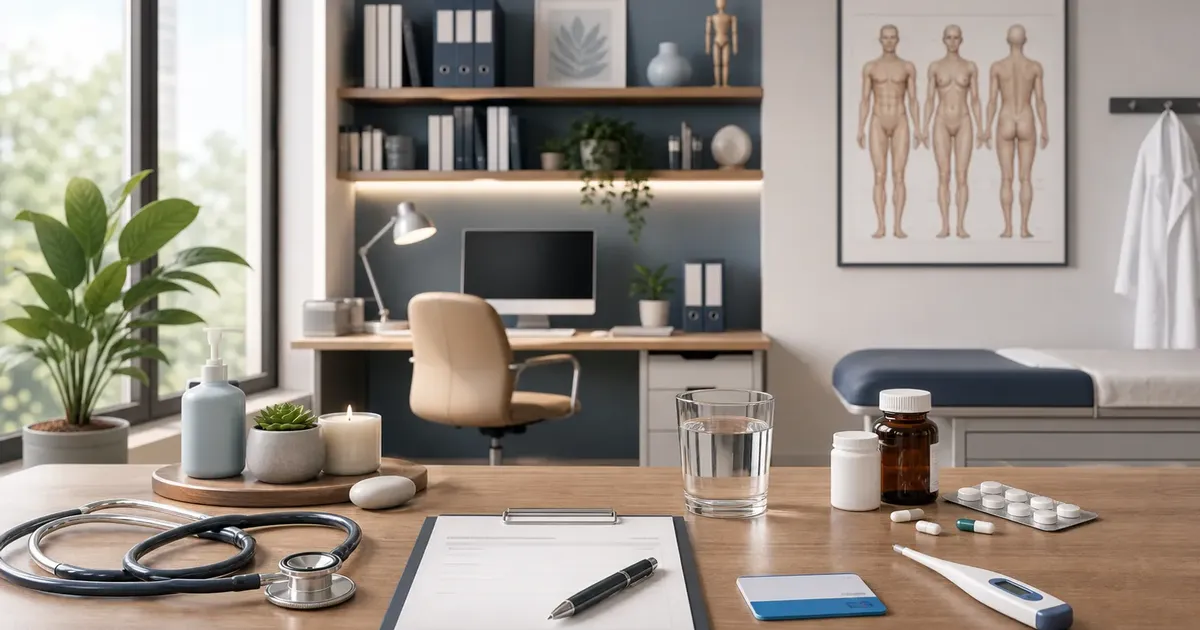
You call or book online for einen Termin, show die Versichertenkarte (health insurance card) and describe what hurts. In the picture above you can find das Stethoskop, das Fieberthermometer, die Tablette and die Liege (examination table). Learn the phrase „Ich habe Schmerzen hier.“ – “It hurts here.”
4. The pharmacy
With a prescription (das Rezept) you go to die Apotheke. Many medicines, even simple ones, are only sold there and not in the supermarket. Ask: „Haben Sie etwas gegen Kopfschmerzen?“ – “Do you have something for a headache?”
5. The bakery
German bakeries are a great place to practise numbers and polite phrases: „Zwei Brötchen, bitte.“ Learn das Brötchen (bread roll), das Brot (bread), die Brezel (pretzel) and der Kuchen (cake).
6. The train station
At der Bahnhof you need die Fahrkarte (ticket), das Gleis (platform), die Abfahrt (departure) and die Verspätung (delay) – a word you will hear often.
7. The office

For your first job or internship: der Schreibtisch (desk), der Laptop, die Tastatur (keyboard), die Besprechung (meeting) and die Uhr (clock). Polite office German starts with „Hätten Sie kurz Zeit?“ – “Do you have a moment?”
Five words to start with today
German | English | বাংলা |
|---|---|---|
der Termin | appointment | অ্যাপয়েন্টমেন্ট |
der Arzt | doctor | ডাক্তার |
die Apotheke | pharmacy | ফার্মেসি |
die Fahrkarte | ticket | টিকিট |
das Brötchen | bread roll | বনরুটি |
Tips for learners from Bangladesh
Use English as a bridge. Many German words look like English: der Laptop, das Telefon, die Adresse. Start with those to build confidence.
Keep Bangla for meaning, German for sound. Read the Bangla translation to understand a word, then listen to the German audio – don't write German words in Bangla letters.
Practise the new sounds. ü, ö and the German r don't exist in Bangla. Ten seconds of listening and repeating per word is enough.
Learn the place before you go there. The evening before your Bürgeramt appointment, study that one scene. You will understand far more the next day.
Start learning German with pictures
The levels A1 to C2 are described in the Common European Framework of Reference for Languages, and the official portal Make it in Germany explains visas, recognition of qualifications and life in Germany. For the words themselves, a picture is the shortest way.
On Visual German every scene shows real places from daily life with each word pinned to the picture, the article in colour, audio, and English and Bangla translations. The whole A1 level is free – create your free account and try your first scene today, or read the frequently asked questions first.
#A1#vocabulary#life in Germany#Bangladesh